
Mass Flow in Aggregate Plants: How to See the Capacity You Already Own
Walk almost any aggregate operation and you will find the same thing hiding in plain sight: crushers, screens, and conveyors capable of producing more than the plant currently sells. The equipment is rarely the constraint. Visibility is.
Most operations only "see" their production at the scale house, after the material is finished and loaded out. Everything that happens in a gap between the crusher and the finished stockpile that stays in a black box. This gap is where hidden capacity, wasted energy, and unaccounted tons quietly live.
Mass flow is how you open the box.
What is Mass Flow in an Aggregate Plant?
Mass flow is the continuous measurement of material moving across a conveyor, expressed in tons per hour (TPH). In an aggregate plant, it shows how much material is processed by the crusher and screen circuit in real time, not just at the scale location.
That distinction matters. A single tonnage reading at the end of the line tells you what you produced. Mass flow across the circuit tells you how you produced it, and where you lost ground along the way. It is the foundation metric that every other plant performance number is built on.
Why Most Aggregate Plants Run Blind
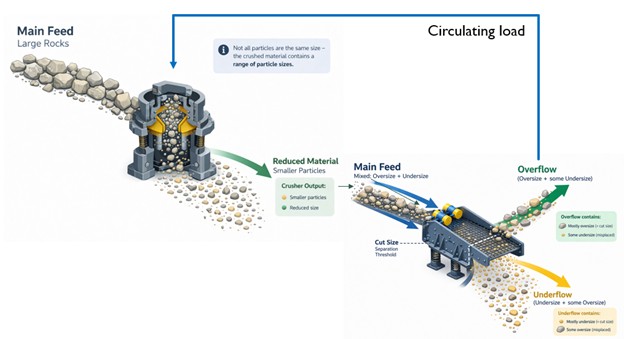
Picture a standard closed circuit. Crushed material leaves the crusher, travels to a vibrating screen, and splits. Desired sized product continues downstream toward the next stage or stockpile, while oversized material returns to the crusher as circulating load to be processed again.
Without mass flow, an operator sees the two ends and none of the middle, leaving them asking tough questions.
Is the crusher actually running at capacity, or is it being underserved? Is the screen overloaded to the point where good product is being misplaced into the reject pile? How much material is being crushed twice because it keeps circulating back?
These are not small headaches. They are the difference between a plant that hits its numbers and one that misses out on tons of material and thousands of dollars.
Where to Measure Mass Flow in a Crusher and Screen Circuit
Once you can measure TPH on the belts in the circuit, the black box becomes a live picture. It takes fewer measurement points than most operators expect. A standard closed circuit needs two.
-
The crusher discharge conveyor feeding the screen. Everything leaving the crusher, mixed oversize and undersize, on its way to separation. This number verifies you are using the crusher capacity you paid for, and it exposes the surges and starvation periods that quietly erode throughput. It also keeps screen loading stable, which protects separation accuracy and product consistency.
-
Oversized stream carrying circulating load back to the crusher. The oversize material the screen rejects and sends back through. This number tells you how much material you are paying to crush more than once.
Those two readings give you the rest of the circuit. Subtract the return from the crusher discharge and you have your fresh feed, which is the same tonnage leaving the screen as correctly sized product bound for the stockpile. That is what you sell.
Compare the return against fresh feed and you have your circulating load ratio, the clearest indicator of whether the circuit is well-tuned or fighting itself. Track that feed number across a shift and you also see how consistently the trucks are unloading to the crusher.
What Does Mass Flow Tell You About Plant Performance?
Here is the shift that changes how you run the plant. Once mass flow is combined with your existing data, equipment design specs, sampling, energy consumption, maintenance history, sales, and inventory, it stops being a tonnage readout and becomes a decision-making system that falls into three practical buckets.
#1 - Production Visibility: Are the Assets Running as Intended?
This is where you catch the plant being off track in real time. Mass flow verifies actual crusher utilization against design capacity, so you can see underfeeding and overloading as they happen, instead of at month’s end.
By comparing flow across every conveyor against equipment ratings, it points directly at the bottleneck, the single transfer point, or the machine that is capping your output.
#2 - Efficiency and Cost Per Ton: Where is Money Leaking?
Excess circulating load is the clearest example. If oversized material keeps returning to the crusher, you are paying to crush the same rock twice, burning energy and adding wear. Mass flow makes that waste visible and measurable.
Pair those tonnage figures with the platform's energy monitoring, running on the same device, and you get energy per ton. That number turns crushing efficiency from a guess into something you can track and optimize.
Then tie cumulative tons to liner and wear-part life, and you can forecast maintenance proactively instead of reacting to it.
#3 - Reconciliation and the Financial Picture: Does Production Match Reality?
A full plant mass flow balance compares total feed against measured product and return streams, validating your reported production and exposing hidden losses.
Comparing tons produced against tons shipped catches discrepancies before they become revenue leakage, while consistently tracking material to and from stockpiles gives you a more accurate inventory, sharpening planning and tightening working capital.
How To Increase Plant Capacity Without New Equipment
Most of the plants reading this already own the crushers, screens, and conveyors needed to produce more; their tons are already there. What’s been missing is the ability to see how those assets are performing, where capacity is bleeding out, and how each fix changes the numbers that matter.
Mass flow gives you exactly that, and it moves four levers at once: lower cost per ton, higher uptime, more accurate inventory, and more sellable tons out the gate.
In turn, your capacity potential is unlocked before you have to sign a purchase order for separate equipment.
How To Capture Mass Flow Without Belt Scales or Added Sensors
Traditionally, this kind of mass flow visibility has meant installing belt scales, embedding sensors, or making structural changes to your conveyors. That is cost, downtime, and calibration headaches most operations would rather avoid.
A simpler solution is Mass Flow Calculation, a component of the Flexco Elevate® Belt Rip Prevention platform.
The system reads material flow directly from the conveyor drive, with no belt scales, no in-belt sensors, no lasers, and no structural modifications. Installation is plug-and-play, and it delivers mass flow visibility alongside the platform's rip detection, drive monitoring, and electrical analysis.
Calibration happens in data, not hardware. To turn what the drive reads into an accurate tonnage figure, the system needs reference data from elsewhere in your process, typically across a two-week window. The more reference data available, and the more accurate that data is, the tighter the output. It is a fair tradeoff for skipping the scales and the structural work, but it is worth knowing up front: what you get out depends on the production data you put in at the start.
In other words, the same device protecting your belt from a catastrophic rip is also showing you the capacity hiding in your circuit.
One important distinction: Flexco Elevate® Belt Rip Prevention is not a verified legal-for-trade scale. For CO₂ billing or trade settlement, it can't replace a certified belt scale. It is built to give you operational visibility into capacity, efficiency, and reconciliation, not to serve as the system of record for regulatory or commercial transactions.
Start With the Capacity You Already Own
You don’t need a full-scale capital project to find more tonnage. What you do need is a system that sees what is already moving through your plant.
Mass flow turns the crusher and screen circuit from a black box into a live picture of where capacity is being made, where it is being lost, and what every adjustment is worth in cost per ton, uptime, and revenue.
The same visibility that protects your belt from a catastrophic rip also shows you the capacity you have been paying for all along. Start by measuring it with Elevate® and letting your numbers tell you where to go next.
Authored by: Rafael Peraza, Heavy-Duty Industry Manager – Cement/Aggregate
Subscribe to the Flexco Blog
Published Date
August 12, 2026Product Groups
- Digital Solutions
- Elevate Belt Rip Prevention
Industry
- Aggregate
Issues
- Belt Damage
- Belt Protection
- Belt Wear
- Downtime